A qualitative study of Local Point, a new student dining hall at the University of Washington
Part 1: Participant Observation
Analysis/Findings
Hierarchy
During my observations of Local Point, I encountered four major players involved in the power dynamics of the space. At the top of this pyramid is the resident manager (in this case a middle aged female). The manager did not take part in the work or dress code of the kitchen staff, but was seen to take charge in training new staff members. Next in the chain of command appears to be Chefs, distinguished by characteristic long sleeved white shirts (usually rolled up to the elbow) black aprons and a beanie of varying patterns and colors. Chefs supervise and work alongside cashiers or servers, distinguished by black short sleeve shirts and black aprons. Females with long hair also wear their hair tied back. Seemingly the lowest ranking grouping, customers of varying characteristics enter and exit the space in waves. Customers rely on kitchen staff to prepare, serve and ring up their food. However, the power of the two groups actually balances because the kitchen staff is obligated to fulfill the requests of customers, as seen through customary questions such as “what would you like,” and “for here or to go?”
The power structure within Local Point can likewise be visually represented. One might explain the entrance to the kitchen as an invisible dividing line. Though there was no explicit rule that prevented customers from entering the kitchen, no customer ever articulated a desire to enter that side of the space. Even when an athletic male seemed to express a connection to the kitchen staff by calling through the entrance, he did not step foot over this “invisible line.” Similarly, when there were no customers placing orders, cashiers/servers chose to recede further into the kitchen area, illuminating a physical distinction between staff and customers. Within the kitchen area itself, coworkers of all levels appeared friendly as they conversed and audibly laughed while on the job. The majority of servers appeared to be students in their 20’s, which likely accounted for the laid back atmosphere.
Social Behavior/Interaction
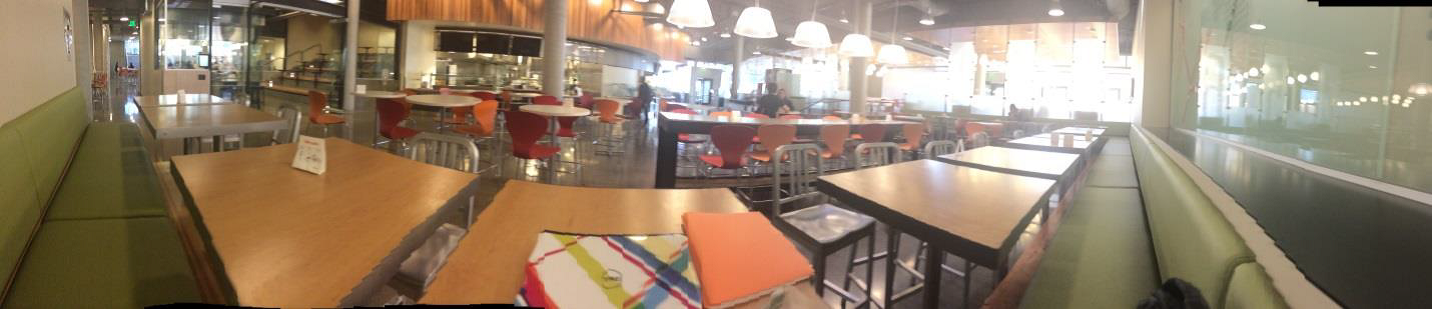
Among the customers of Local Point, those that seated themselves in front of the grill section seemed to follow a few distinctive social norms. Between all parties, those eating tended to heed what I now call the Five Foot Rule. Out of the 30 seated groupings that I observed, all but one pair selected a table that was at least five feet from another seated individual. This arrangement was most obvious along the back wall booth seating. People were clearly spaced out to every other table as long as crowd levels allowed spacing. At the long table, people always selected seats at either end as if to avoid mixing parties in the middle. In the case of the small circular tables, people often chose to skip a table if one was occupied, but not all. Nevertheless, these tables were themselves spaced about 5ft apart, possibly satisfying this inherent desire to distance oneself from unknown persons. There was one case that initially appeared to disprove this theory; two males who actually chose the table directly to my right during one of my observatory periods. However, the outlying nature of additional behavioral habits leads me to believe that this may have been a unique set of circumstances. Both males spoke solely in what I believed to be Mandarin Chinese and, should they have, in fact, been international students as I suspect, this may simply mark a larger divergence in social behaviors among different cultures. In which case, I feel that, without any other instances of breaks in the pattern, it would be sufficient to further investigate the Five Foot Rule with the stipulation that it relates specifically to the social influences of American culture.
Technology
Though related to the interaction taking place between persons, I regard technology as a separate theme because of its involvement with an exterior artifact, which adds its own context to each social situation. I found that the prominent technology being used during the time of my observations were smartphones, iPods and laptops. Surprisingly, while phone type varied, all laptops were Macs (except for my own Dell) this may reflect the technology choices of a demographic likely to use a laptop in Local Point or it may merely be a result of the significantly small sample size collected over a few hours of observations. Nonetheless, one trend that quickly emerged from the data was the increased likelihood of a solo-eater utilizing some form of technology (regardless of gender). Of the 30 groupings observed, 11 out of 15 solo-eaters were actively engaged with some form of technology (primarily cell phones). On the flip side, 13 out of 15 groups did not contain members that were visibly engaged with technology. These numbers strongly suggest that some key difference between groups and solo-eaters provokes a desire to engage with technological devices when eating alone. Paired with behavioral observations, such as the introverted body language adopted by a majority of solo-eaters, these findings have me speculating that solo-eaters experience lowered confidence levels while eating in public settings, causing them to seek social interaction through technological means (perhaps by text message, social media or the web in general).
Part 2: Interviews
Analysis/ Findings
Hierarchy
Through my observations, I identified three major components of Local Point’s hierarchical structure: Chefs, servers/cashiers and customers. My informants all took the perspectives of customers. From this perspective, they generally characterized these positions equivocally, but by naming different identifying characteristics then I had as an observer. “Chefs” were described generally as “adult staff” and servers/cashiers as “student staff” or sometimes simply as “students,” suggesting that student customers draw a line between current age and educational status rather than physical work or job descriptions. Similarly, several informants explicitly expressed sympathy or respect for adult staff, stating things like “the adult staff are really nice; very approachable.” On the other hand, mistakes were often associated with “student” staff members. In this regard, student staff members appear to be seen as less competent and reliable than adult staff members.
Despite general agreement that the staff members are “nice” and “good” people overall, customers seem to hold a subtle sense of entitlement when it comes to receiving service. For example, Nemo described frustration during an instance when a student staff member failed to notice her at the counter. Dory likewise articulated annoyance when faced with slow service, and sub-par sandwich making in the deli section. Ultimately, these narratives suggest that despite a customer’s connections to student staff members as peers, student staff members tend to be the source of customer frustration during the food ordering process.
Social Interactions/ Behavior
During my observations, I noted that customers tended to sit at least one table away from each other while eating, a statement that was further supported when Dory explained “If I’m by myself I tend to be like at least a table away from them,” in reference to her seating habits. All four informants described “isolating” or “distancing” themselves from people while eating alone. However, not all informants seemed to view this separation in a negative light as I had suspected. Codename Alfa Omega especially appeared to appreciate eating alone as an outlet, a time to “look around at people” and “surf the internet.” Nemo, Dory and Rose, on the other hand, openly “avoided” solo-eating in public because it stirred up emotions including “loneliness” and “depression.” Even so, Rose brought up a curious point by explaining that if she eats alone she studies or “think[s] about school.” Earlier she had summarized her view of food as a “break time from studying,” suggesting that eating alone actually contradicts what she intends to accomplish through eating. Namely, taking her mind off of studying.
Further to the point, none of the informants indicated displeasure when eating with a group. Related group activities including “talking” and “joking” seemed to play an important role in lifting morale. As Rose puts it, “Not everyone is going to say they are stressed, but you know they are, because you know exactly how they feel going to school.” Evidently, social interaction serves as a vital “stress reliever” for students (the primary customers at Local Point) and when this interaction is not provided, students fall victim to their own discontents. From these incites, I speculate that this heightened stress increases sensitivity to external factors such as “loud groups” and the fear of “judgment” that Nemo highlighted during her interview. This may then lead to the introverted mannerisms exemplified by solo-eaters during my observations.
Student/Customer Values
From the standpoint of the observer, food related trends within the space appeared minimal. However, after talking with customers in person, it became immediately clear that food is, in fact, a central focus for Local Point’s customers. As Codename Alfa Omega frankly exclaims, “It’s the only reason why I go there.” Clearly, students utilize the dining hall first and foremost as a source of food. Nonetheless, one should not mistake use of the dining hall as an indication of overall contentment with its services. To the contrary, each informant passionately addressed several disappointments and concerns, especially in relation to food quality. Although food is the focal point of Local Point visits, customers seem to find much left to be desired.
Overall, Local Point’s food is described unanimously as “just bad” or of “poor quality,” with the exception of salads and sandwiches, which appear to be relatively fool proof as far as preparation goes. Concerns about the healthiness of food were also addressed. Codename Alfa Omega talked about a lack of vegetables and the “greasiest pizza I’ve ever had!” Similarly, Rose specifically accuses the UW of not putting enough thought into quality ingredients, preferring instead to distribute sub-par products that are “not good for studying.” In this, a correlation between food quality and academic performance begins to take shape.
Cost also plays a role in student dissatisfaction. Of those interviewed, all described food as “overpriced” in some capacity. However, threats to pursue better, cheaper food on the Ave appeared largely empty. Despite heated dismissal of Local Point’s catering, each student returned to the vicinity, suggesting that they valued something greater than food quality or cost put together. In time this factor presented itself explicitly as “convenience.” While the District Market and other dinning locations remain at a feasible distance from West Campus dorms and apartments, students seem more willing to sacrifice other values for the sake of convenience. Even so, it is put forward that even the District Market “doesn’t have that good of food anyway,” further minimizing access to agreeable student dining options. In light of these statements, it seems reasonable to assume that Local Point and other West Campus eateries are not actually satisfying the wants and needs of the students which they serve. Whether or not this is due to indifference on the part of Housing and Food Services (HFS) or a genuine misrepresentation of the student body remains to be explored.
 Megan Taylor